


In the high-stakes world of healthcare revenue cycle management, there is a phrase that keeps CFOs awake at night: “The Hidden Tax.” This isn’t a government levy, but rather the billions of dollars lost annually to administrative friction. In 2026, the complexity of payer rules and the sheer volume of data have made manual claims management not just difficult, but financially dangerous.
The traditional reactive model—where you wait for a denial to arrive before investigating the “why”—is no longer sustainable. Organizations are now shifting toward a futuristic, preventive stance: AI Denial Prediction. By using artificial intelligence to “see around corners,” healthcare providers are moving from a defensive posture to a proactive one, effectively stopping revenue leakage before it even begins.
The 2026 Denial Crisis: A Rising Tide
According to a report by a Trusted Platform, claim denial rates have climbed steadily, with nearly one-third of healthcare providers now reporting denial rates of 10% or higher. For a large health system, this represents hundreds of millions in delayed or lost revenue. The root causes are often deceptively simple: missing prior authorizations, minor coding mismatches, or outdated eligibility data.
However, in 2026, payers are also using increasingly sophisticated algorithms to scrutinize claims. To level the playing field, providers must adopt Proactive Claim Prevention strategies that are as intelligent as the systems they are submitting to.
The True Cost of a Denial
- Direct Revenue Loss: Claims that are never resubmitted or are definitively rejected.
- Administrative Burden: The average cost to rework a single denied claim has risen to nearly $30–$40 in labor alone.
- Cash Flow Volatility: High “Days Sales Outstanding” (DSO) that ties up capital needed for patient care and facility upgrades.
How AI Predicts the Unpredictable
AI Denial Prediction isn’t magic; it’s an advanced application of pattern recognition. While a human coder might catch a common error, an AI engine can analyze millions of historical data points to identify subtle correlations that the human eye would miss.
1. The Pre-Submission “Scrub”
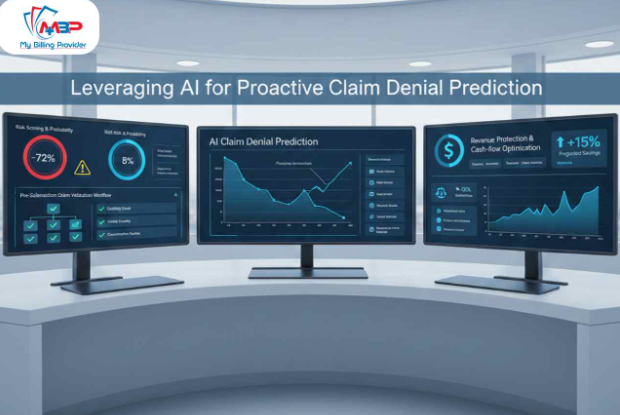
Think of AI as an ultra-intelligent, real-time auditor. Before a claim is ever sent to a payer, the system performs an AI-Powered Denial Prevention check. It cross-references the patient’s clinical documentation, the assigned codes, and the specific payer’s current policy logic.
If the AI detects a 75% probability that the claim will be denied for “lack of medical necessity,” it flags the claim for immediate human review before submission.
2. Denial Management Analytics: Finding the Root Cause
Prediction is only half the battle. AI also excels at post-denial analysis. By aggregating “remittance advice” data, it identifies systemic trends.
Example: If Payer X suddenly starts denying all claims for a specific cardiac procedure in the Northeast region, the AI detects this shift in real-time. It doesn’t just tell you the claim was denied; it tells you why the payer’s logic changed, allowing you to update your front-end workflows instantly.
Comparing the Old Way vs. the AI Way in 2026
The transition to Healthcare Claim Denials 2026 standards requires a fundamental change in how we view the “clean claim rate.”
| Feature | Traditional Reactive RCM | AI Denial Prediction |
| Focus | Denial Recovery (fixing mistakes) | Proactive Claim Prevention |
| Logic | Static, rule-based edits | Dynamic, machine-learning models |
| Timing | Post-submission (days/weeks later) | Real-time (pre-submission) |
| Insight | Categorical (e.g., “Coding Error”) | Specific (e.g., “Missing Modifier 25 for Payer Z”) |
| Impact | High “Cost-to-Collect” | Maximum Net Patient Revenue |
Unique Insight: The Rise of “Agentic AI” in RCM
In 2026, we are seeing the emergence of “Agentic AI”—systems that don’t just predict a denial but autonomously take steps to prevent it. For instance, if an AI identifies a missing prior authorization, it can automatically navigate to the payer portal, gather the required clinical notes from the EHR, and initiate the authorization request without human intervention.
This level of AI-Powered Denial Prevention turns your revenue cycle into a self-healing system, significantly reducing the “administrative noise” that distracts clinicians and billers alike.
Why My Billing Provider is Your Partner in Revenue Integrity
At My Billing Provider, we don’t just manage denials; we eliminate the conditions that create them. Our suite of AI-driven solutions is built to handle the unique complexities of Healthcare Claim Denials 2026.
Fulfilling Your 2026 Needs:
- Predictive Precision: Our powerful algorithms evaluate complex medical records and payer-specific histories to assign a “risk score” to every claim, ensuring Proactive Claim Prevention is baked into your workflow.
- Integrated IPDRG Coding: We leverage AI to bridge the gap between clinical documentation and code assignment, ensuring maximum accuracy and compliance.
- Scalability for Any Volume: Whether you’re a specialized clinic or a multi-state hospital network, our flexible platform handles your volume without compromising speed.
- **Actionable **Denial Management Analytics****: We provide clear, transparent dashboards that help you understand your financial health at a glance, highlighting the exact areas where process improvements can yield the highest ROI.
Our committed team of professionals is here to support you on your path to better financial performance. We provide individualized advice and cutting-edge technology to help you revolutionize your coding and billing operations.
Conclusion: The Future of RCM is Proactive
The days of simply “submitting and hoping” are over. To thrive in the 2026 healthcare economy, providers must leverage AI Denial Prediction to secure their revenue and protect their mission. By focusing on Proactive Claim Prevention, you can redirect resources from chasing paper to caring for patients.
Are you ready to stop the “denial spiral” and optimize your revenue?
Contact My Billing Provider today to learn more about our AI-powered solutions and how they can transform your revenue cycle. Our team is ready to show you how predictive intelligence can revolutionize your financial health. Reach out to us for a personalized consultation and take the first step toward a more efficient, accurate future.