

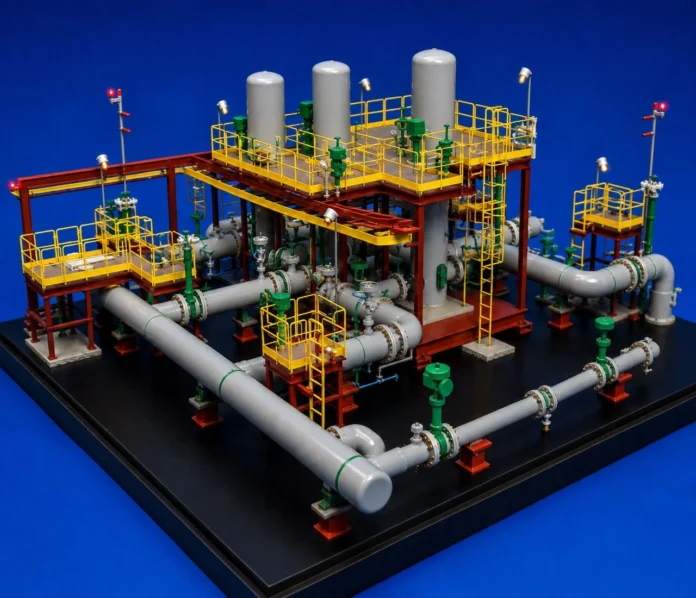

Walk into the design office of a process plant twenty years ago, and there was a good chance you’d find a scaled plastic replica of the plant sitting in the corner. Rows of pipes, tiny valves, vessels, pumps and steel structures, all laid out in miniature. Engineers would gather around it, point, argue and adjust. Then the industry moved to computer-based design, and many people assumed those physical replicas would disappear.
They didn’t. A well-made piping model is still being ordered today, for reasons that have less to do with nostalgia and more to do with how people actually think.
So, what exactly is it?
In simple terms, it’s a scaled, three-dimensional replica of a pipe network, usually together with the equipment it connects to. That might mean a single unit of a refinery, a pump house, a full process area, or a complete plant. The pipes run at the right heights and routes, valves sit where they should, and vessels, exchangers and structural supports are included in their proper positions.
The scale depends on the purpose and the space. Ratios in the range of 1:25 to 1:100 are typical, with larger scales used when fine detail such as flanges, supports and instrument connections needs to be visible. Some versions are plain and technical, while others are colour-coded and polished for presentations.
A bit of history
Before three-dimensional software became common, physical models were a standard part of plant design. Designers built them from plastic components and assembled them at set stages of the project. Entire teams used them to review layouts, check clearances and agree on routing before construction began.
Computers eventually took over most of that work. Modern design tools can detect clashes automatically, generate isometrics and produce reports. Yet many companies still choose to build a physical version alongside the digital one, especially for high-value or high-risk projects.
Why a physical version still helps
The obvious reason is understanding. A screen shows a slice of the design, controlled by whoever is holding the mouse. A physical piece lets several people look at different areas at once. Somebody kneels down to check valve access at floor level while another leans over to see the pipe rack from above. Conversations happen naturally, and issues get raised earlier.
There’s also the matter of intuition. Experienced operators and maintenance engineers often spot practical problems on a physical replica that don’t jump out in a digital review. A valve handwheel that’s too high to reach, a line that blocks a walkway, a pump with no room to remove its motor. These are the kinds of things people feel in their bodies when they look at a scaled object, even before they can explain why.
Finally, not everyone reads drawings. Clients, financiers, local officials and plant managers may need to understand a layout without a technical background. A model speaks to all of them equally, and it does so without anyone needing to install software or learn a new interface. You just walk up and look.
Common ways teams use one
Design review is the classic use. Before construction drawings are frozen, teams walk around the replica to check access, maintenance space, escape routes and overall arrangement. Changes at this stage cost almost nothing, compared with changes on site.
Construction planning is next. Project managers use it to talk through sequences: where cranes will stand, which pipe spools go in first, and how heavy items will be brought in. It’s much easier to explain a lifting plan to a subcontractor with a model between you.
Training comes third. New operators can learn the plant layout before they enter a live process area, and maintenance crews can practise finding isolation points. Some companies keep the replica in the control building for exactly this reason.
Finally, there’s marketing and bidding. Engineering firms and fabricators use models to stand out in competitive tenders, giving clients a tangible sense of what’s being proposed.
What makes a good one
Accuracy comes first. The replica should follow the approved layout closely, with pipe routes, elevations and equipment positions matching the design data. If the model shows something the drawings don’t, or the other way round, it loses credibility quickly.
Readability comes second. Colour coding by service, such as process fluids, steam, water and air, makes a network of hundreds of lines understandable at a glance. Clear tags on major equipment and a simple legend are useful.
Durability is third. Thin plastic pipes and glued joints can look fine on day one and start to droop after a year under lights. Good makers use rigid materials, proper supports and clean joints so the model still looks sharp after years of use.
Things to think about before ordering
Decide how much of the plant needs to be shown. Modelling everything is rarely necessary, and it can push cost and size beyond what you need. Often a key process unit or a difficult area gives most of the value.
Agree on what level of detail is required. Should small-bore lines and instruments be included? Are supports and hangers important? Every extra detail adds time, so choose the ones that help the people who’ll actually use the replica.
Think about updates. If the design changes, will you need the model changed too? Some are built with removable sections so revisions can be made without starting again.
Finally, think about timing and cost. Both are driven mainly by pipe count and equipment density, not by the size of the plant on paper. A compact unit crammed with small-bore lines can take longer than a spread-out area with big, simple pipes. Share your drawings early, so the maker can estimate honestly, and keep a little flexibility in the schedule. Rushing precision work is how crooked lines and poorly glued joints make it into the final result.
Where to go from here
If you’re at the stage of thinking through your options, it’s worth looking at how a specialist approaches a piping model from drawings to final delivery. Seeing the process, and the finishing standard, makes it much easier to decide what you actually need.
Final thoughts
Digital design has changed how plants are engineered, but it hasn’t changed how people understand space. A good piping model gives teams a shared, physical reference that everybody can read, touch and question. For complex layouts, tight schedules and expensive mistakes, that’s a small investment with a very practical return.